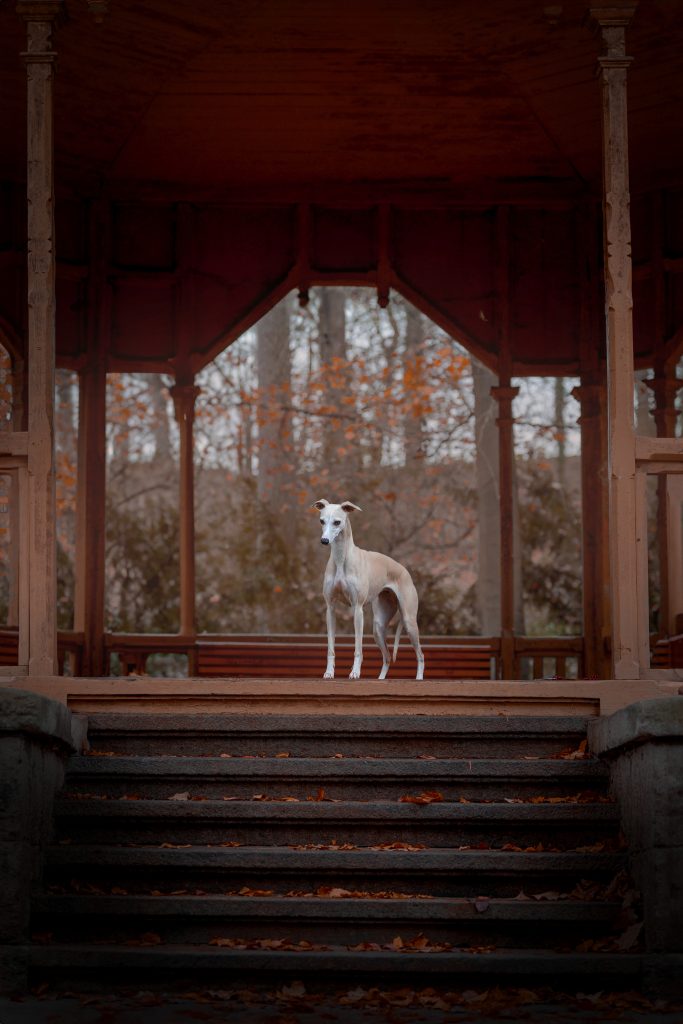
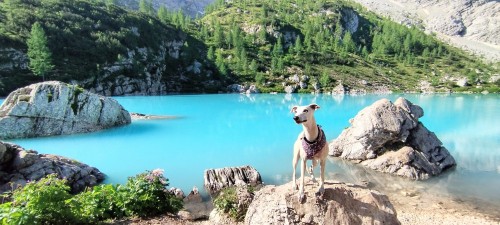
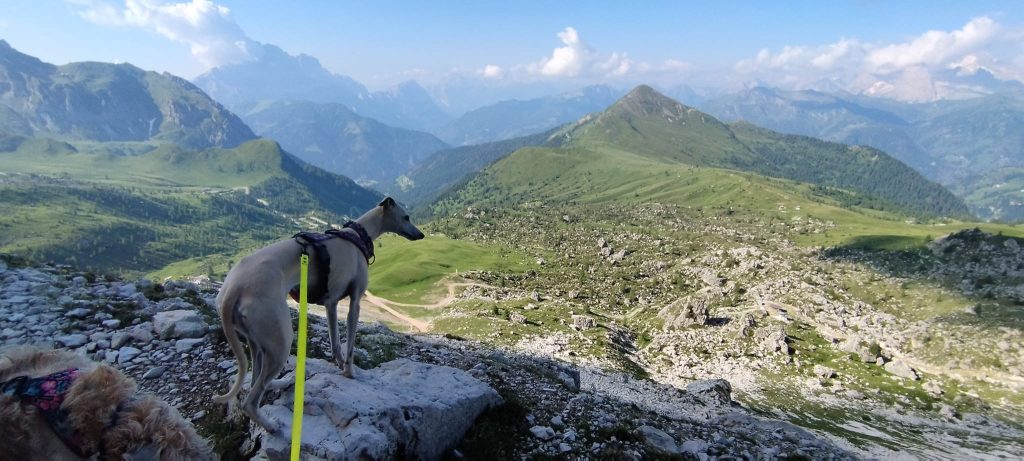
Whippet – Elegance in Motion
Lightweight, fast, and incredibly graceful. The Whippet is a master of speed, yet also a gentle companion who loves the comforts of home. It combines a sporty spirit with a calm temperament—ideal for those looking for a dog full of energy and love.

The Fascinating Whippet Breed
This section presents the main characteristics of the breed.
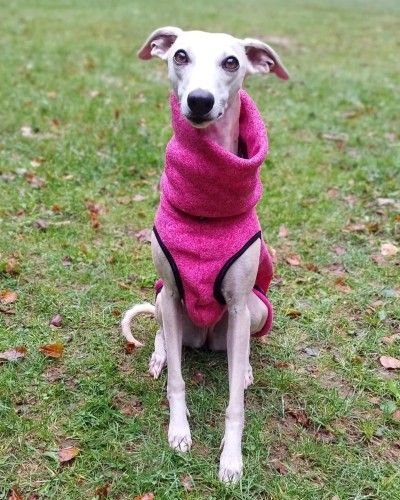
An elegant physique
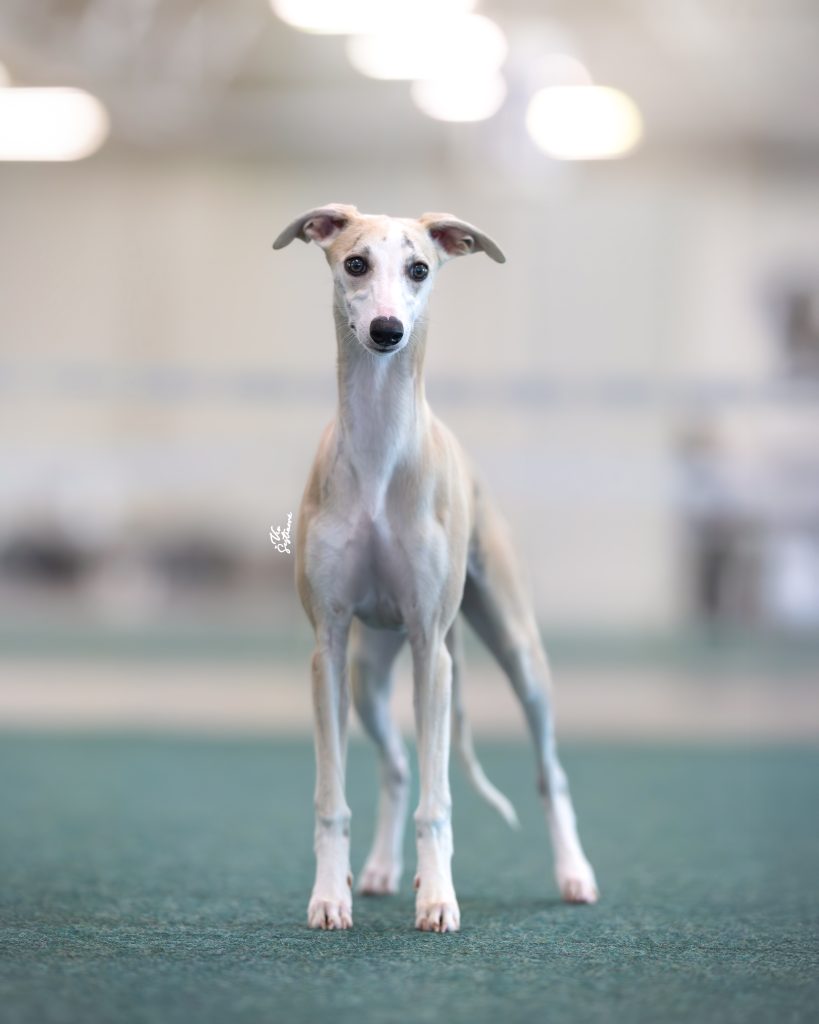
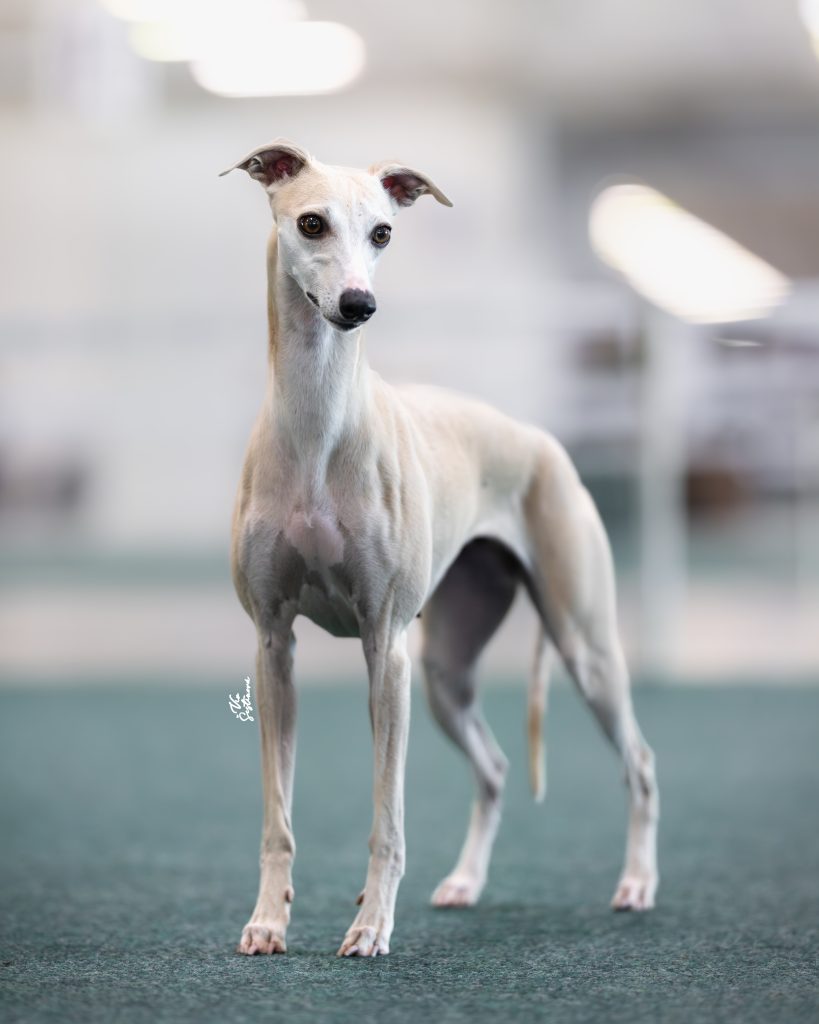
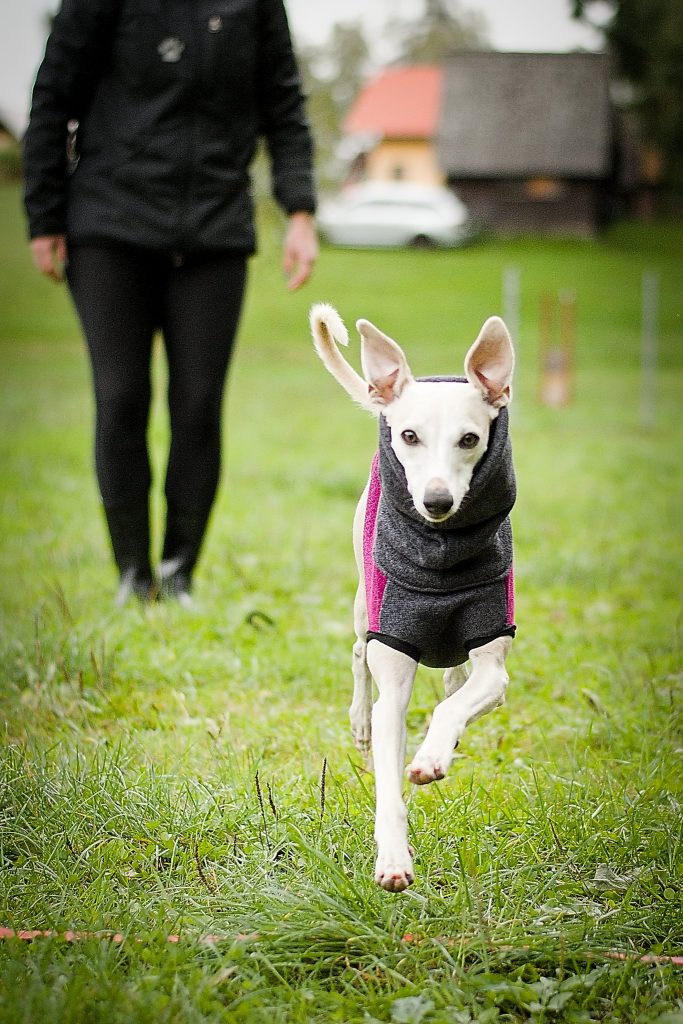
Whippets are known for their slender and athletic build.
Speed and Agility
These breeds excel in speed and possess exceptional agility.
Friendly nature
Whippets are very friendly and get along well with both people and other animals.
Care and Supplies
This breed does not require special care. It has a short coat, so frequent brushing is not necessary, and it has no undercoat, so the coat is very soft. Once in a while, you can run a rubber glove through its coat, which will also massage the skin. The Whippet is notable for not having the typical doggy odor. Frequent bathing is not recommended, as it unnecessarily dries out the skin.
It's important to trim their nails and brush their teeth.
History and Breed Standard
History
The breed is said to have been developed relatively late, in the 19th century, and quite intentionally, as a smaller version of its larger relative, the greyhound. This was reportedly achieved by crossing the Greyhound with various terrier breeds. Among these, the Old English Black and Tan Terrier is most often cited as one of the Whippet’s ancestors. The Italian Greyhound is also considered an ancestor of the Whippet. In that case, the Whippet would be the result of crossbreeding the Italian Greyhound with terrier breeds. Such crossbreeding is said to have occurred for the first time about 200 years ago. The terrier believed to have contributed to the Whippet’s origin in this instance was the Fox Terrier. It is occasionally mentioned, albeit with some caution, that it might have been a “small greyhound.” Perhaps this is precisely the key to the whippet’s past. There are, in fact, paintings dating back about 600 years that are said to depict what are undoubtedly small greyhounds—whippets.
Natural breeds that are not bred in an organized manner are characterized by a considerable range in height at the withers. Even the ancestors of today’s large English greyhound were not all approximately the same size in the past. Therefore, these old paintings do not necessarily depict whippets; they may depict “only” small greyhounds. We can regard them as evidence that even back then, certain evolutionary branches of smaller sighthounds may have emerged here and there, which—from a working perspective—might have had various advantages over their larger relatives. Last but not least, the breed’s tendency to grow larger than average serves as evidence that the Whippet may have originated from older, larger ancestors (shared ancestors with the Greyhound).
The Whippet was first shown as a distinct breed at a dog show in 1891, though under the name “Snap Dog.” The name could be very loosely translated as “a dog for catching or chasing.” This would imply that the Whippet—or its immediate ancestor—must have been a hunting dog. However, the interpretation of the name “Snap Dog” could also be quite different; it might have referred to the prey itself. It is true that in the past, when greyhound racing on the track first began, the Whippet was used as live bait, released with a slight head start ahead of the pack of racing greyhounds. After some time, the live decoy on the racetrack was replaced by an artificial one (a hare or rabbit skin—and in more recent times, even a simple plastic bag).
Source: Greyhounds: I. Stuchlý – M. Císařovský
Standard
COUNTRY OF ORIGIN: United Kingdom
DATE OF PUBLICATION OF THE ORIGINAL VALID STANDARD: March 6, 2007.
USES: racing dog.
F.C.I. CLASSIFICATION: Group 10: Sighthounds.
Section 3: Short-haired Sighthounds
. No working trials required.
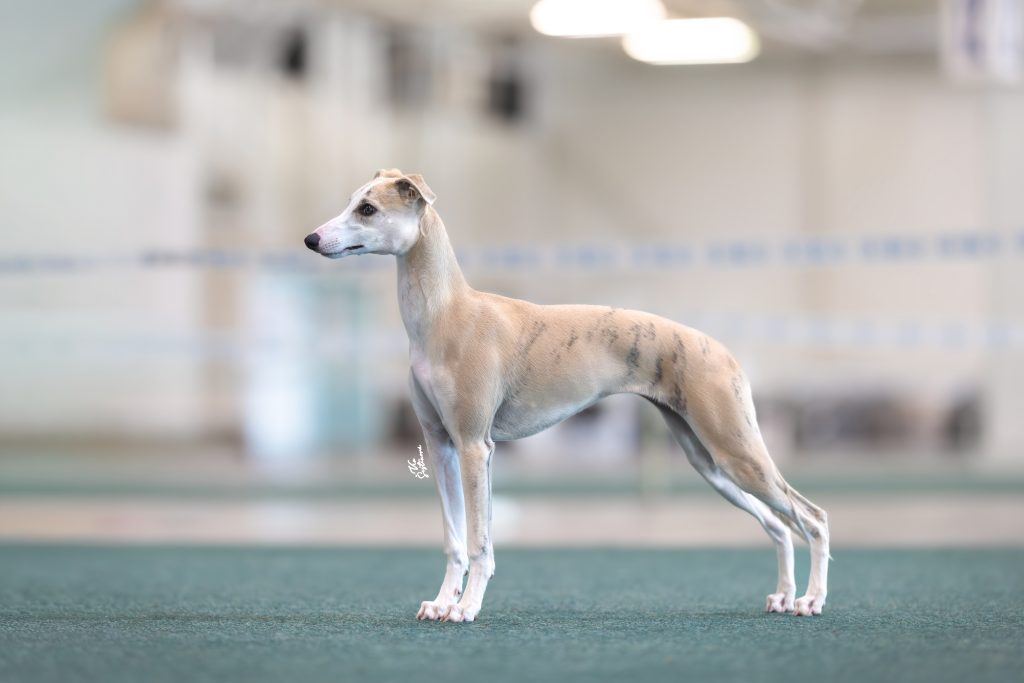
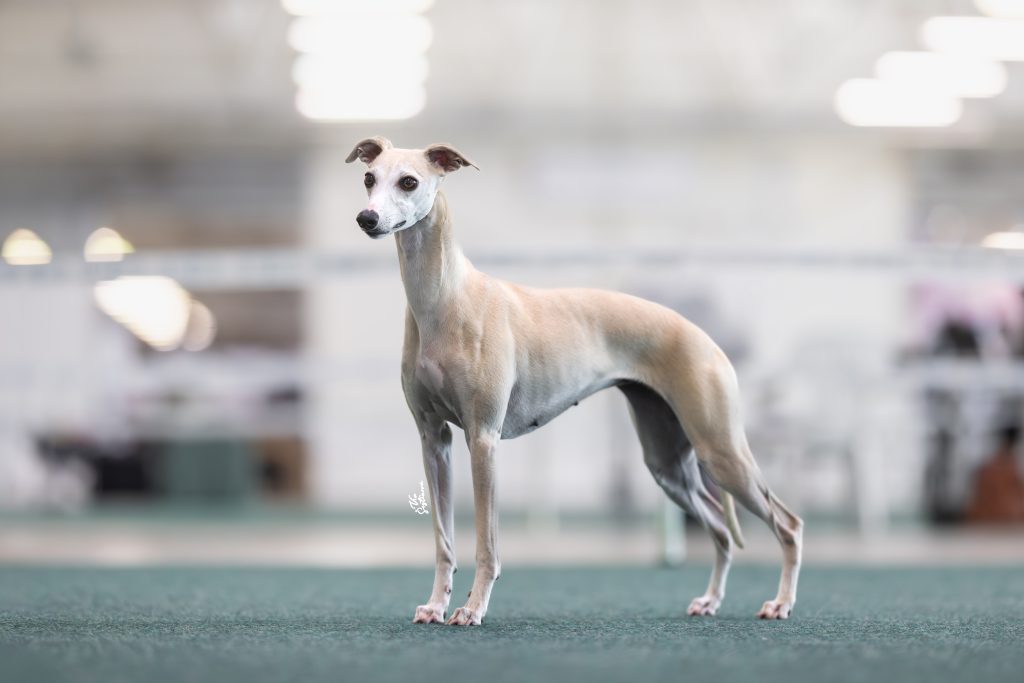
GENERAL APPEARANCE: A balanced combination of musculature and strength with elegance and graceful lines. Built for speed and performance. Any form of exaggeration should be avoided.
BEHAVIOR / TEMPERAMENT: An ideal companion. Highly adaptable in both home and sports settings. Gentle, affectionate, and even-tempered.
HEADING
SKULL: Skull: Long and lean, with a flat crown; tapers toward the muzzle; relatively broad between the eyes. Stop: Slight.
FACE: Nose: Black; bluish in blue dogs; the same color as the coat in liver-colored dogs; in isabel, cream, or other light-colored dogs, any color except pink. Only in white or spotted dogs is a “butterfly” nose permissible, but it must not be completely depigmented. Jaws/Teeth: Jaws strong, powerful, well-shaped, with a perfect scissor bite, i.e., the upper incisors closely overlap the lower incisors and are set perpendicular to the jaws. Eyes: Oval, bright, with a very alert expression. Ears: Rosette-shaped, small, with fine skin.
NECK: Long, muscular, elegantly arched.
BODY: Topline: Forms a graceful arch at the loins, but is not hunched. Back: Broad, well-muscled, firm, and rather long. Loins: Give the impression of mass and strength. Chest: Very deep, providing ample space for the heart; deep ribcage, well-shaped. Ribs well-sprung and well-muscled toward the back. Belly: Distinctly tucked up.
TAIL: Without a tuft. Long, tapering; carried in a slight curve when in motion, but does not rise above the level of the back.
LIMBS:
FOREQUARTERS: The forequarters are straight and vertical; the front is not too broad. Shoulders: Sloping and muscular. The shoulder blades extend to the top of the spine, where they are clearly defined. Elbows: Well set under the body. Pasterns: Strong, slightly springy.
HINDQUARTERS: Strong. When standing, the dog covers a large area. Thighs: Broad. Stifles: Well angulated. Calves: Well developed. Hocks: Set low.
PAWS: Very clearly defined; the toes are well-spaced, with well-arched joints; strong and firm pads.
GAIT / MOVEMENT: Perfectly free movement. Viewed in profile, a long, natural stride is visible, and the topline is firm. The forelimbs have a good reach, low to the ground; the hindlimbs reach well under the body, allowing for a powerful stride. Overall, the gait must not be stiff or high-bowed, nor should it be short or choppy. The gait is correct when viewed from the front and from the rear.
HAIR GROWTH
COAT: Fine, short, with a dense texture.
COLOR: Any color or combination of colors.
SIZE: Height at the withers: Males 47–51 cm (18 1/2–20");
Females 44–47 cm (17 1/2–18 1/2").
FAULTS: Any deviation from the points listed above must be considered a fault, and its evaluation must be in exact proportion to its severity and its impact on the dog’s overall health and well-being.
DISQUALIFYING FAULTS:
- aggressiveness or timidity.
Individuals exhibiting physical or behavioral abnormalities must be disqualified.
Note: Dogs must have two visibly normal testicles that are fully descended into the scrotum.